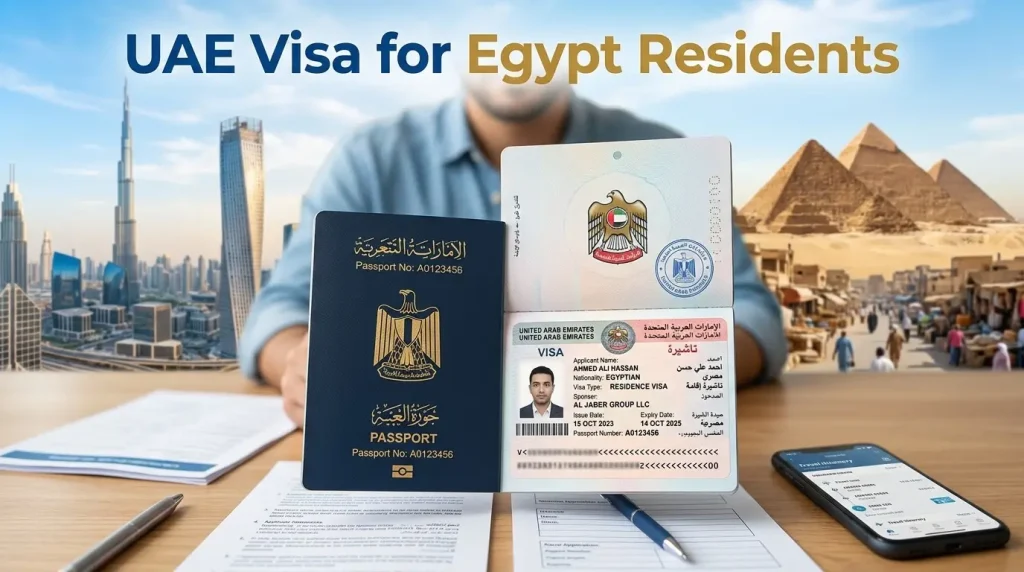
If you are an Egyptian passport holder planning to travel to the UAE this year, this guide will tell you what most other websites will not: visas are still being issued, and the process is largely digital, but 2026 has brought real complications that you need to understand before you apply. From the political backdrop to step-by-step application instructions, fee breakdowns, and what to do if your visa gets rejected, everything is here.
What Has Changed in 2026
Before diving into requirements and fees, you deserve a straight answer to the question that is circulating in every Egyptian travel forum right now: Why are so many Egyptian visa applications being rejected this year?
The Political Background You Need to Know
Egypt and the UAE have a 50-year strategic partnership built on shared language, culture, and economic interdependence. The UAE is one of the largest Arab investors in Egypt, with billions flowing into energy, real estate, ports, and financial services. Egyptian workers, professionals, and entrepreneurs form one of the largest expat communities in the Emirates. That relationship is real and it is not going away.
However, 2026 has introduced complications that are quietly affecting how UAE immigration handles Egyptian applications.
Early 2026: The Yemen and Sudan intelligence episode. In January, reports emerged that Egypt had shared intelligence with Saudi Arabia regarding UAE military activities in Yemen and Sudan. Egyptian officials were concerned about Emirati support for armed factions operating near Egypt’s borders. This created quite diplomatic friction at a time when both governments were still maintaining warm public statements.
February–May 2026: The Iran war realignment: When the United States and Israel launched military strikes on Iran on February 28, 2026, the regional picture shifted rapidly. Iran responded with missile and drone attacks targeting UAE territory, with the UAE intercepting hundreds of ballistic missiles and over a thousand drones throughout the conflict.
President El-Sisi made multiple visits to Gulf states, including a formal fraternal visit to Abu Dhabi on March 19 and again on May 7, 2026, and held direct calls with UAE leadership, publicly stating, “What affects the UAE affects Egypt.” Egypt has since positioned itself firmly as a supporter of UAE sovereignty, with Egyptian fighter jets stationed on UAE territory confirmed publicly by the UAE Ministry of Defense on May 7, 2026.
What this means for your visa: Despite the public warmth, travel agencies across the UAE have reported a noticeable drop in Egyptian tourist visa approval rates since early 2026. UAE immigration authorities have made no official announcement about restrictions, and Egyptian visas are not banned.
However, background screening is significantly tighter than in previous years. The consensus among visa professionals is that this is a temporary security-enhanced screening response to regional instability, not a permanent policy change.
The bottom line: Visas are being approved. But the bar is higher, the checks are more thorough, and incomplete applications that would have sailed through in 2024 are now being rejected. Every single document needs to be perfect.
Do Egyptian Residents Need a Visa for the UAE?
Yes. Egyptian passport holders must obtain an electronic entry permit before boarding any flight to the UAE. There is no visa-on-arrival option for Egyptian citizens. Your visa must be approved and in your hands, as a digital PDF, before you arrive at the airport in Egypt. The permit is logged in the UAE’s national security database and tied to your passport number.
Types of UAE Visas Available to Egyptian Residents
Choosing the wrong visa category is one of the fastest ways to get rejected. Here is a clear breakdown of every option and who it is actually for.
Tourist Visa (30 or 60 Days)
This is the most common visa for Egyptians visiting for leisure, sightseeing, or spending time with friends. You apply independently; no sponsor inside the UAE is required.
- 30-day tourist visa: Best for a short trip or family visit. Single entry. If you leave the UAE and want to return, you need a new visa.
- 60-day tourist visa: Better value if you plan to stay longer, explore multiple emirates, or want a relaxed timeline. Also, single entry by default.
Both can be applied for through UAE airlines (Emirates, Etihad, Air Arabia, and FlyDubai), licensed travel agencies in Egypt, or official UAE government portals.
Important 2026 update: All tourist visa permits are now digitally linked to your UAE Pass identity profile. Once issued, the permit is attached to your identity in the UAE system, which makes entry smoother but also means any flag on your profile will surface immediately.
Visit Visa (Sponsored, 30 or 60 Days)
A visit visa is for travellers who have a specific host inside the UAE, a family member, a close friend who is a resident, or a licensed UAE company.
Who can sponsor you:
- A family member holding a valid UAE residence visa
- A UAE resident friend (in some cases)
- A licensed UAE company
How sponsorship works in 2026: The sponsor must submit your application through the ICP Smart Services portal using their Emirates ID. They upload your documents, pay the fees with a UAE-issued card, and receive the permit on your behalf. You cannot submit a sponsored visit visa yourself from Egypt.
Grace period removed: As of 2026, the old 10-day grace period after visa expiry has been officially eliminated. You must exit or extend your visa on or before the exact expiry date printed on your permit. There is no buffer.
Employment Visa
If you have a job offer from a UAE employer, you do not apply for this yourself. Your employer handles everything through the 2026 “Work Bundle” platform, a single portal that merges the Ministry of Human Resources (MOHRE) and the ICP into one application. You will receive your entry permit considerably faster than in previous years once your employer initiates the process.
Under no circumstances should you enter on a tourist visa, intending to look for work once you arrive. Working on a tourist permit is illegal, carries heavy fines, and can result in a travel ban.
H3: Business Visa
Designed for Egyptian entrepreneurs and professionals travelling for a specific business purpose, attending a conference like GITEX or COP, meeting investors, conducting due diligence on a free zone setup, or negotiating contracts. It allows professional activity without requiring full residency. This is not a substitute for an employment visa if you intend to work for a UAE company long-term.
Transit Visa
If Dubai is a stopover on your way to Europe, North America, or East Asia, a transit visa lets you leave the airport and experience the city.
- 48-hour transit visa: Free of charge. Valid for a brief overnight stay.
- 96-hour transit visa: Costs approximately AED 50. Gives you four days to explore the UAE before your onward flight.
Both must be arranged before you travel, not on arrival.
Golden Visa (10-Year Residency)
The UAE Golden Visa is available to Egyptian doctors, engineers, scientists, investors, and entrepreneurs who meet specific thresholds. It grants 10-year renewable residency with no local sponsor required and the right to sponsor your immediate family. Applications go through the ICP portal and are assessed individually.
If you qualify, this is worth pursuing; it removes the cycle of annual visa renewals permanently.
Green Visa (5-Year Residency for Freelancers)
The Green Visa is a 5-year self-sponsored residency designed for skilled workers and freelancers. It is ideal for Egyptian professionals who want to work independently in the UAE without needing a company to sponsor them.
Many Egyptian professionals prefer this over the standard employment route because it gives them full control over their work arrangements. Entry point requirements and costs are lower than for the Golden Visa.
UAE Visa Requirements for Egyptian Residents: The Full 2026 Document List
This is where most rejections happen. Read this section carefully.
Standard Documents Required for All Applications
1. Passport (valid for at least 6 months) Your Egyptian passport must have a minimum of six months of validity remaining from your intended date of entry into the UAE, not from your application date. If you are cutting it close, renew your passport first. Applications with passports expiring sooner than six months from entry are automatically rejected.
Your passport must also be machine-readable (the two lines of letters, numbers, and chevrons at the bottom of your photo page). Handwritten or older non-machine-readable Egyptian passports are not accepted.
2. Passport photo: A recent color photograph against a plain white background. Your face must be centered, eyes open, mouth closed, no headwear unless required for religious reasons, and no glasses. The photo must be taken within the last six months.
3. Passport external cover scan (MANDATORY NEW REQUIREMENT FOR 2026 )This is the most important new rule and the most common reason applications are being rejected right now. You must submit a high-resolution color scan of the physical external cover of your Egyptian passport, the green or gold front cover with the eagle emblem.
The UAE’s AI verification system uses this image to authenticate the physical document and cross-reference it against the biographical page. Applications submitted without this scan are now automatically rejected by the system before a human reviewer even sees them. The scan must be sharp, well-lit, and in full colour. A dark, blurry, or partial scan will also trigger rejection.
4. Police Clearance Certificate (PCC) (MANDATORY NEW REQUIREMENT FROM APRIL 2026) Egypt is on the UAE’s official list of nationalities now required to submit a Police Clearance Certificate, also called a “good conduct Certificate, for new visa applications.
This was confirmed by the ICP and circulated to authorised typing centers on April 11, 2026. It applies to employment visas, residence visas, and family visas. Tourist and visitor visa applicants should also include it, as applications without it are increasingly being rejected at the screening stage.
The PCC is an official document issued by your home country confirming you have no criminal record. Here is exactly how to get one as an Egyptian applicant applying from Egypt:
Step 1: Obtain the PCC from Egyptian authorities. Apply for a criminal record certificate (صحيفة الحالة الجنائية) from the Egyptian Ministry of Interior. This can be done through the Ministry’s online portal or in person at a governorate office. Processing typically takes 3 to 7 working days.
Step 2: Attest at the Egyptian Ministry of Foreign Affairs (MOFA). Take the original PCC to the Egyptian MOFA’s attestation department in Cairo (Corniche El Nil, Maspero area) or their offices in other governorates. This confirms the document is genuine and officially issued.
Step 3: Attest at the UAE Embassy in Cairo. Take the MOFA-attested document to the UAE Embassy in Cairo (5th Settlement, New Cairo) for legalisation. The embassy confirms the MOFA stamp is valid. Fees and turnaround times vary; check the embassy’s current schedule before visiting.
Step 4: Final MOFA UAE attestation (if required for employment visas). For employment and residence visas, your employer in the UAE may need to complete a final attestation through the UAE’s Ministry of Foreign Affairs after you arrive. Confirm this step with your employer.
Important notes on the PCC:
- The PCC is valid for 3 months from the date of issue. Do not apply too early — if it expires before your visa process is complete, you will need to obtain a fresh one.
- If you are currently inside the UAE on a previous residence permit, you must obtain a locally issued UAE Police Clearance Certificate instead through the Dubai Police app, Abu Dhabi Police portal, or MOI Smart Services for other emirates.
- The full attestation chain (PCC → Egyptian MOFA → UAE Embassy) can take 3 to 4 weeks. Factor this into your overall timeline.
- Paying your fine does not clear an absconding record; the PCC and any pending legal cases must be resolved separately.
Additional Documents for Specific Visa Types
For visit visas (sponsored):
- Sponsor’s Emirates ID copy
- Proof of relationship if sponsored by family (marriage certificate, birth certificate, translated and attested if in Arabic only)
- Sponsor’s salary certificate or proof of residency status
For tourist visas applied for independently:
- Confirmed return flight booking or onward ticket
- Proof of accommodation (hotel reservation or host address)
- Proof of financial means: the informal benchmark used by UAE immigration is a minimum of AED 3,000 (~40,000 EGP) for a 30-day visit, shown as a consistent balance over 3 to 6 months. A sudden large deposit immediately before applying is a red flag; officers look for regular salary deposits and normal transaction history, not a lump sum injected the week before submission. A credit card with a clearly available limit is also acceptable. For the 5-year multiple-entry tourist visa, the requirement rises to USD 4,000 maintained over the previous 6 months.
For business visas:
- Invitation letter from the UAE company or event organiser
- Your company’s trade registration or professional credentials
- Purpose of visit clearly documented
For employment visas: Your employer in the UAE handles the visa application through the Work Bundle platform. However, your educational certificates must be fully attested to before your employer can submit. Here is the exact attestation chain:
- Egyptian MOFA attestation: Take your degree or diploma to the Egyptian Ministry of Foreign Affairs attestation office for authentication
- UAE Embassy in Cairo legalisation: Take the MOFA-attested certificate to the UAE Embassy in Cairo (5th Settlement) for legalisation
- UAE MOFA final attestation: After you arrive in the UAE, your employer submits the documents to the UAE Ministry of Foreign Affairs for the final stamp
Each step takes 3 to 7 working days on average. The full attestation chain from start to finish typically takes 3 to 5 weeks, so begin this process as soon as you receive your job offer; do not wait until your employer asks for the documents.
How to Apply: Three Legitimate Routes
Route 1: Apply Through a UAE Airline (Recommended for Most)
If you are flying with Emirates, Etihad, Air Arabia, or FlyDubai, you can apply directly through the “Manage Booking” section of their website after purchasing your ticket. This is often the most reliable route because the airlines have direct relationships with UAE immigration, and their systems are well-integrated. Processing is typically fast, and the airline’s customer service can help if something goes wrong.
Steps:
- Book your flight
- Go to “Manage Booking” on the airline’s website
- Find the visa application section
- Upload all required documents including the passport cover scan
- Pay the fee
- Receive your PDF permit by email within 3–5 working days (or under 24 hours on the Express AI-Verified Lane if all documents are perfect)
Route 2: Apply Through a Licensed Travel Agency in Egypt
Agencies in Cairo and Alexandria can handle the full application on your behalf. This is worth considering if you find the online process confusing or if you want someone to review your documents for errors before submission. Many agencies also bundle mandatory travel insurance into the package price, saving you the trouble of sourcing it separately.
Important: Only use agencies that are officially licensed. Ask to see their accreditation. Scams in this space are common; always verify you are dealing with a legitimate operator.
Route 3: Apply Through a UAE Sponsor via the ICP Portal
If someone in the UAE is sponsoring your visit, they submit the application themselves through the ICP Smart Services portal (icp.gov.ae). They will need your passport copy, photo, and the passport cover scan. They pay the fee using their UAE-issued card. You receive the permit by email once approved.
Official Government Portals (Apply Directly)
For independent applications without an airline or agency:
- ICP Federal Authority: icp.gov.ae
- GDRFA Dubai: gdrfad.gov.ae
Use only these official portals. Do not pay third-party websites that charge extra “processing fees” for submitting to the same portals.
Fees: What You Will Actually Pay in 2026
All 2026 UAE visa fees are all-inclusive; the price now covers mandatory digital processing and basic insurance, so there are no surprise add-ons from the government’s side. Agency or airline service fees are separate and vary.
| Visa Type | Govt Fee (AED) | Incl. VAT & Service (AED) | Approximate EGP (incl. fees) |
| 30-day tourist visa | AED 200 + 5% VAT | ~AED 350–550 | ~4,700–7,400 EGP |
| 60-day tourist visa | AED 300 + 5% VAT | ~AED 600–900 | ~8,000–12,100 EGP |
| 48-hour transit visa | Free | Free | Free |
| 96-hour transit visa | ~AED 50 | ~AED 50–100 | ~670–1,350 EGP |
Important note on fees: The official GDRFA government fee is AED 200 for a 30-day visa and AED 300 for 60 days (plus 5% VAT). However, if you apply through an airline, travel agency, or online platform, service charges are added on top; the total all-in cost typically lands between AED 350–550 for 30 days and AED 600–900 for 60 days.
The EGP equivalent shifts with the exchange rate, so always verify at the time of application. The lower figures apply when applying directly through official portals; airlines and agencies charge more.
Processing Times and Sample Timeline
Standard processing: 3 to 5 working days for most applications.
Express AI-Verified Lane: If every document, including the passport cover scan and PCC, is submitted in perfect quality, the AI system can issue your visa in under 24 hours. This is genuinely fast, but the AI is unforgiving. One blurry scan or a missing document kicks you back to standard processing or triggers an outright rejection.
In 2026, given tighter screening, Allow more buffer than you think you need. The PCC attestation chain alone takes 3 to 4 weeks. Here is a realistic day-by-day timeline working backwards from your travel date:
| Day | Action |
| Day 1 (as early as possible) | Apply for PCC from Egyptian Ministry of Interior |
| Day 5–8 | PCC ready, take to Egyptian MOFA for attestation (3–5 days) |
| Day 10–15 | Take MOFA-attested PCC to UAE Embassy in Cairo for legalisation (3–5 days) |
| Day 16–20 | Scan all documents: passport bio page, passport cover, photo, PCC, bank statement, return ticket, hotel booking |
| Day 21 | Submit visa application through airline portal, licensed agency, or ICP/GDRFA |
| Day 22–26 | Standard processing (3–5 working days), monitor your email |
| Day 27 | Visa approved, receive PDF by email, print a physical copy |
| Day 28–30 | Travel |
This 30-day end-to-end timeline assumes no complications. If your PCC has an issue or your application is rejected once, add 10 to 14 days for resolution and resubmission.
Emirate-Specific Processing Differences
The fine rate and visa rules are the same across all seven emirates, but the operational experience differs:
Dubai (GDRFA): Tourist and visitor visa applications through Dubai-based airlines or agencies are processed via the GDRFA. Dubai has the most service points, the most digitised processes, and typically the fastest turnaround. Express processing through Emirates or FlyDubai is usually the most reliable channel.
Abu Dhabi and other federal emirates (ICP): Processed through the ICP portal. Abu Dhabi tends to be slightly slower than Dubai during peak periods due to volume. For employment visa applications processed through the Work Bundle in Abu Dhabi-based companies, build in an extra 3 to 5 days.
For sponsored visit visas specifically, If your sponsor is in Sharjah, Ajman, or the Northern Emirates and submitting through ICP, processing times can run 5 to 7 working days even on standard applications. Sharjah ICP in Al Rahmaniya handles a high volume of blue-collar and domestic worker applications that can slow the queue.
Key rule: Your visa is processed by the authority linked to your sponsor or airline, not the emirate you plan to visit. You can be sponsored by someone in Sharjah and spend your entire trip in Dubai; the sponsoring authority is what determines the processing channel.
After Approval: What You Need at the Airport
Once your visa is approved, a PDF will arrive in your email.
- Print a physical copy and bring it with you. Digital versions are technically accepted, but a hard copy is safer and speeds up the immigration process.
- Bring your return ticket or proof of onward travel. Immigration officers will ask for this.
- Have proof of funds ready, a credit card, a bank statement, or sufficient cash. You should be able to show you can cover your expenses for the duration of your stay.
- Make sure the name on your visa exactly matches the name on your passport. A single character difference can mean being turned away at the border.
Visa Extensions: How to Stay Longer Without Leaving
The 2026 digital system has made extensions much more convenient. You no longer need to do a “border run” to Oman or take a short flight to extend your stay.
For tourist visas:
- A 30-day tourist visa can be extended twice, each adding 30 days (total possible stay: 90 days)
- A 60-day tourist visa can be extended once for an additional 30 days (total: 90 days)
- The absolute ceiling for tourist visa holders is 120 days. total stay
- Extensions must be applied for at least 5 to 7 days before your current visa expires
- Apply through the ICP app (non-Dubai visas) or GDRFA portal (Dubai-issued visas) entirely online; no exit required
- Extension fee: approximately AED 500–630 in government fees, plus VAT, Knowledge Dirham charges, and in-country processing surcharge, the total typically comes to AED 1,000–1,200, which is considerably more than the original visa fee
Critical: The grace period has been removed. If you miss the extension deadline and your visa expires, you begin accruing fines immediately.
Overstay Fines: The New Unified System
The UAE has simplified its fine structure for 2026. Previously, fines varied between emirates. Now there is a single unified rate:
AED 50 per day for every day you remain in the UAE after your visa expires. This applies across all seven emirates without exception. With the automated tracking system now triggering penalties immediately on expiry, there is no ambiguity and no room for appeal on standard overstays.
The March 2026 Airspace Closure Waiver (now closed): Due to flight disruptions caused by Iranian missile attacks beginning February 28, 2026, the ICP announced on March 4 that overstay fines would be waived for travellers unable to depart.
The waiver covered fines incurred from February 28 onward and applied to tourist and visitor visa holders, cancelled residency permit holders, and exit permit holders stranded by flight cancellations. This waiver expired on March 31, 2026, and has since been fully closed. The standard AED 50 per day fine has been reinstated since April 21, 2026. If you were affected during that period and have not yet applied for the waiver, contact ICP directly to check eligibility.
Why Egyptian Visas Are Being Rejected in 2026: The Real Reasons
Understanding why rejections happen is the most practical thing you can take from this guide. Here are the actual causes, in order of how common they are right now:
Context on rejection rates: Travel agencies operating in both Egypt and the UAE have reported noticeably higher rejection rates for Egyptian tourist visa applications since early 2026 compared to the same period in 2024.
While UAE immigration authorities have not published official approval statistics, visa professionals estimate rejections have roughly doubled for tourist visa applicants who submit without the PCC or with substandard document scans. The good news is that this means the majority of rejections are for fixable reasons, not background flags.
1. Missing or poor-quality passport cover scan. This is the single biggest reason for rejections in 2026. If the scan is missing, dark, blurry, partial, or low resolution, the AI system rejects it automatically. Scan the cover in bright natural light or under a good lamp, use a flatbed scanner if possible, and save it as a high-resolution color JPEG or PDF. Do not photograph it with your phone at an angle.
2. Missing Police Clearance Certificate. From April 2026, Egypt is on the UAE’s mandatory PCC list. Applications submitted without an attested PCC or with an expired one (validity is 3 months from issue) are rejected. This is now the second most common cause of Egyptian visa rejections. The PCC must be attested through the full chain: Egyptian MOFA → UAE Embassy in Cairo → (for employment visas) UAE MOFA.
3. Previous overstay on record If you overstayed a UAE visa on a previous trip, your name is flagged in the immigration database. This does not automatically mean you will be rejected forever, but it significantly increases scrutiny. Be honest in your application and consider attaching a letter of explanation.
4. Heightened security screening due to regional tensions. As discussed above, applications are undergoing more thorough background checks in 2026 than in previous years. This is not something you can directly address, but submitting the strongest possible application with every document included gives you the best chance.
5. Inaccurate or mismatched personal information. Any discrepancy between the name, passport number, or date of birth on your application and what is printed in your passport will trigger rejection. Check everything three times before submitting.
6. Non-machine-readable passport Older Egyptian passports without the machine-readable zone at the bottom of the photo page are not accepted. If your passport is an older format, you need to renew it before applying.
7. Incomplete or unclear supporting documents: blurry passport photo page scan, expired residence visa still showing as active in the system, or missing sponsor information. Every document must be clear, complete, and current.
8. Sponsor issues. For visit visas, if the sponsor’s residency visa has expired or their Emirates ID is not up-to-date, the application will fail even if your own documents are perfect. Ask your sponsor to verify their status before initiating the application.
What to Do If Your Visa Is Rejected
Rejection is not the end of the road. Here is what to do:
Step 1: Identify the actual reason. The rejection notification should give a reason. Read it carefully. Most rejections are for fixable document issues, not a fundamental ban on your entry.
Step 2: Do not immediately reapply with the same documents. If your documents caused the rejection, resubmitting them unchanged will get you rejected again. Fix the problem first.
Step 3: Consider the reconsideration option. Through the ICP portal, you can submit a formal reconsideration request with additional supporting documents. This is especially useful if you have prior UAE entry records, professional credentials, or a compelling travel purpose. Medical, educational, or family emergency situations can support a reconsideration review.
Step 4: Apply through a different channel. If you applied through an agency and were rejected, try applying directly through an airline, or vice versa. Sometimes the channel matters.
Step 5: Give it time. Given the current screening environment, some applications are simply taking longer. If you applied well in advance and received no decision rather than an outright rejection, follow up rather than assume the worst.
Tips That Actually Improve Your Chances in 2026
Start the PCC process immediately, before anything else. The full attestation chain takes 3 to 4 weeks. This is now the longest item on your preparation list. Do not leave it until after you have booked your flight.
Make sure your bank statements show a consistent balance, not a sudden large deposit. Aim for at least AED 3,000 (~40,000 EGP) as a minimum visible balance for a 30-day trip. Regular salary credits and normal spending patterns over 3 to 6 months are far more convincing to a reviewer than a freshly topped-up account.
Include your full travel history. If you have Schengen, US, or UK visa stamps in your passport, photograph those pages and attach them to your application as supporting documents. A history of legitimate international travel is a strong positive signal.
Attach proof of stable employment or business ownership in Egypt. A recent salary certificate, employer letter, or trade registration makes it clear you have strong ties to Egypt and a reason to return. This addresses the immigration concern about people overstaying.
If you have lived in the UAE before, use your UAE Pass. Existing UAE Pass holders with a clean residency history process faster and face less friction in the system.
Make sure every name is identical across every document. Your application, your passport, your flight booking, and your hotel reservation should all show exactly the same name in exactly the same format.
Do not apply too far in advance. UAE tourist visa validity begins from the date of issue, not your date of entry. If you apply three months early, your visa may expire before you travel. Apply once your PCC is ready and your travel date is confirmed, typically 2 to 3 weeks before departure.
Double-check your passport expiry before anything else. Six months of validity from entry date, not application date.
Long-Term Options: Living and Working in the UAE
If short-term visits are not what you are looking for, here are the two most practical pathways for Egyptians seeking long-term residency.
The Golden Visa (10 Years)
Available to Egyptian doctors, engineers, scientists, exceptional students, investors, and entrepreneurs. The 10-year Golden Visa requires no local sponsor, allows you to live, work, and study freely, and gives you the right to sponsor your entire immediate family. Applications are submitted through the ICP portal and assessed based on your credentials and documentation.
The Green Visa (5 Years for Freelancers and Skilled Workers)
The 5-year Green Visa is the self-sponsored residency option for Egyptian professionals who want independence. You do not need a UAE employer to sponsor you. You need to demonstrate your skills, income, and professional standing.
This is increasingly popular with Egyptian professionals in technology, media, consulting, and the creative industries. While the Green Visa requires meeting specific eligibility thresholds, many Egyptian professionals find it more accessible as an initial entry point than the Golden Visa.
Sponsoring Your Family
Egyptians resident in the UAE can sponsor family members to join them, provided you meet a minimum monthly salary of AED 4,000 plus employer-provided housing, or AED 4,000 plus a housing allowance. The family sponsorship process moved to a fully digital system in 2026 through the Work Bundle platform.
Frequently Asked Questions
Which visa is best for a first-time Egyptian traveller to the UAE? The 30-day single-entry tourist visa is the standard starting point. It is the most affordable, straightforward to apply for, and sufficient for most short trips or family visits.
What is the minimum passport validity required?
Six months from your intended date of entry into the UAE. Not from the application date, from the entry date.
Can I extend my tourist visa without leaving the UAE?
Yes. Tourist visas can be extended twice, each for 30 days, through the ICP app without leaving the country. Apply at least five days before your visa expires.
Can I work on a tourist visa? No. Working on a tourist or visitor visa is strictly illegal in the UAE. It carries heavy fines and can result in a travel ban. If you have a job offer, your employer must process an employment visa through the Work Bundle platform.
What is the police clearance certificate, and do all Egyptians need it?
From April 2026, a PCC, also called a Good Conduct Certificate, is a mandatory requirement for Egyptian nationals applying for UAE employment, residence, and family visas. Tourist and visit visa applicants are also strongly advised to include it, as applications without it are increasingly rejected.
The PCC must be obtained from the Egyptian Ministry of Interior, attested by the Egyptian MOFA, and then legalised by the UAE Embassy in Cairo. Start this process at least 4 weeks before your planned application date because the attestation chain takes time.
Why was my visa rejected even though my documents looked correct?
In 2026, the most likely culprits are either the passport cover scan (missing or insufficient quality for the AI system) or the missing PCC (mandatory for Egyptians from April 2026). Check both first.
If those were fine, the rejection may be linked to tighter background screening related to regional tensions. Consider the reconsideration process through the ICP portal or apply through a different channel.
How long do rejections take to resolve?
Straightforward document-related rejections can be resolved and resubmitted within a few days. More complex cases involving previous overstays or background checks can take several weeks. Build this time into your travel planning.
Is the UAE visa process fully online for Egyptians?
Yes. The entire application can be completed digitally through airline portals, licensed agency websites, or official UAE government portals. You do not need to visit an embassy or consulate.
Are UAE visas getting harder to get for Egyptians permanently?
The current tighter screening is widely believed to be temporary, linked to the regional security situation in 2026. Travel professionals expect approval rates to normalise once the geopolitical picture stabilises. There is no official announcement of any permanent change in policy toward Egyptian applicants.
Visa rules, fees, and processing requirements are determined by UAE immigration authorities and subject to change. Always verify current requirements through the ICP portal (icp.gov.ae) or GDRFA Dubai (gdrfad.gov.ae) before applying.