
- Home
- Family Sponsorship Visas
Family Sponsorship Visas
If you’re living in the UAE on a valid residence visa, you can sponsor your family to live with you. The rules changed a few years ago regarding all visas; this also includes family sponsorship visas; job title is no longer a condition. What matters now is your salary.
Types of Family Visas in the UAE: Which One Do You Need?
If you are planning to bring your family to the UAE, the first step is figuring out which visa actually fits your situation. The right choice depends on how long they are staying and whether you are sponsoring them or they are visiting independently.
Here is a clear breakdown of the four main options.
1. Family Visit Visa
This is the visa to choose when your family members want to visit you for a specific period, a holiday, a wedding, or just to spend time together. They do not live with you permanently. They come, stay, and leave.
- Who is it for: Parents, siblings, or other relatives visiting you temporarily.
- How long it lasts: Usually 30, 60, or 90 days. You choose the duration when you apply.
- Who applies: You apply as their sponsor through ICA, GDRFA (Dubai), or a typing center.
- What happens after: The visa expires when they leave or at the end of the stay. No Emirates ID is issued.
2. Tourist Visa for Family
This option looks similar to a visit visa, but there is one key difference: the visitor does not need a resident family member to sponsor them. It is designed for tourists coming purely for leisure, often arranged through airlines or travel agents.
- Who is it for: Family members traveling together as tourists, even if you (the resident) are not sponsoring them.
- How it works: Often bundled with flight tickets or hotel bookings through airlines like Emirates, Etihad, or Flydubai.
- How long it lasts: Typically 30 or 60 days.
- Who applies: The traveler or a travel agent handles it. You do not need to be a UAE resident to apply for this visa.
- Think of it this way: If your parents are coming to visit you and you are paying and sponsoring, that is a Family Visit Visa.
If your cousin and their family are stopping in Dubai for a week on their way to somewhere else and booking through an airline, that is a Tourist Visa.
3. Family Residence Visa
This is the visa most expats work toward. It allows your spouse, children, or parents to live with you in the UAE full-time. They get a residence visa and an Emirates ID, just like you have.
- Who is it for: Your direct family members who will live with you.
- Spouse: You must meet a minimum salary requirement (usually AED 4,000 or AED 3,000 plus accommodation).
- Children: Sons can be sponsored until age 18 (or 21 if studying). Daughters can be sponsored until married, regardless of age, in most cases.
- Parents: You can sponsor parents if you meet a higher salary requirement and have proof that they are dependent on you.
- How long it lasts: Usually 1, 2, or 3 years, renewable.
- What they get: A residence visa sticker (now digital) and a physical Emirates ID.
- Where to apply: Through ICP for most emirates, or GDRFA if you live in Dubai.
4. Golden Visa for Family
This is not a regular family visa. It is a separate program for long-term residency, and it works differently. If you qualify for a Golden Visa, your family can be sponsored under it, but the rules are specific.
- Who is it for: Investors, entrepreneurs, specialized talents, researchers, and outstanding students.
- How long it lasts: 5 or 10 years, automatically renewed.
- How it works for family: If you hold a Golden Visa, you can sponsor your spouse and children (including sons up to age 25) without the usual restrictions. There is no salary requirement for the sponsor.
- Who applies: You apply for the Golden Visa first. Once approved, you add your family members to it.
Important: Do not confuse this with a standard family visa. The application process, the documents required, and the benefits are completely different.
If someone tells you they can get a “Golden Visa for family” without you personally qualifying as an investor or specialist, that is not correct.
Quick Comparison
Visa Type | Purpose | Duration | Who Sponsors | Emirates ID Issued? |
Family Visit Visa | Temporary visit (holiday, event) | 30, 60, or 90 days | UAE resident | No |
Tourist Visa | Leisure travel | 30 or 60 days | Airline or travel agent | No |
Family Residence Visa | Living together permanently | 1, 2, or 3 years | UAE resident (you) | Yes |
Golden Visa (Family) | Long-term residency for select groups | 5 or 10 years | The Golden Visa holder | Yes |
Which One Should You Choose?
- If your wife and children are coming to live with you while you work here, you need the Family Residence Visa.
- If your parents are visiting for three months to see the grandkids, go with the Family Visit Visa.
- If your brother is bringing his family for a holiday and you are not sponsoring them, they should get a Tourist Visa through an airline.
- If you are a doctor or investor with a Golden Visa, you already know it. Your family rides on that status.
Who Can You Sponsor?
Family Member | Requirements |
Wife | Valid attested marriage certificate |
Children | Sons up to 25 years, unmarried daughters of any age |
Stepchildren | Possible with NOC from the biological parent and deposit |
Newborns | Apply within 120 days of birth to avoid fines |
Parents | Higher salary requirements, sponsor both together |
Parents-in-law | Possible under the humanitarian route |
Salary Requirements for Family Sponsorship
Family Member | Minimum Monthly Salary | Notes |
Wife and children | AED 4,000 or AED 3,000 + accommodation | Job title no longer matters |
Parents (standard) | AED 20,000 | Sponsor both parents together; deposit required |
Parents (humanitarian) | AED 10,000 + suitable housing | Discretionary route through GDRFA |
Parents-in-law | AED 10,000 | Humanitarian route, case-by-case |
First-degree relatives (visit visa) | AED 4,000 | For parents, spouse, and children on a visit |
Second/third-degree relatives | AED 8,000 | For cousins, aunts, and uncles on a visit |
Friends | AED 15,000 | For visit visas |
Sponsoring Parents, What You Need to Know
Parents are the trickiest. The rules are stricter and the costs higher. Here’s the honest picture.
Salary Requirements:
Situation | Minimum Monthly Salary |
Both parents (standard route) | AED 20,000 |
Both parents (humanitarian route) | AED 10,000 + suitable housing |
One parent only | Usually not allowed; must sponsor both |
Other Requirements
- Accommodation: Your apartment must have a separate room for parents. The tenancy contract should show enough space.
- Security deposit: AED 5,000–10,000 per parent. Refundable when they leave or if the visa is cancelled.
- Medical insurance: Mandatory. Valid in the UAE. Covers them fully.
- Visa duration: 1 year only. Not 2 or 3 like spouse and children. Renew every year.
The Humanitarian Route
If you earn between AED 10,000 and 19,999, you can still apply. But it’s not automatic. You need:
- A letter explaining why parents must live with you (health reasons, no other caregivers, etc.)
- Medical reports, if applicable
- Approval comes on a case-by-case basis. No guarantees.
Step-by-Step for Parents
- Step 1: Apply for an entry permit (same as spouse/children).
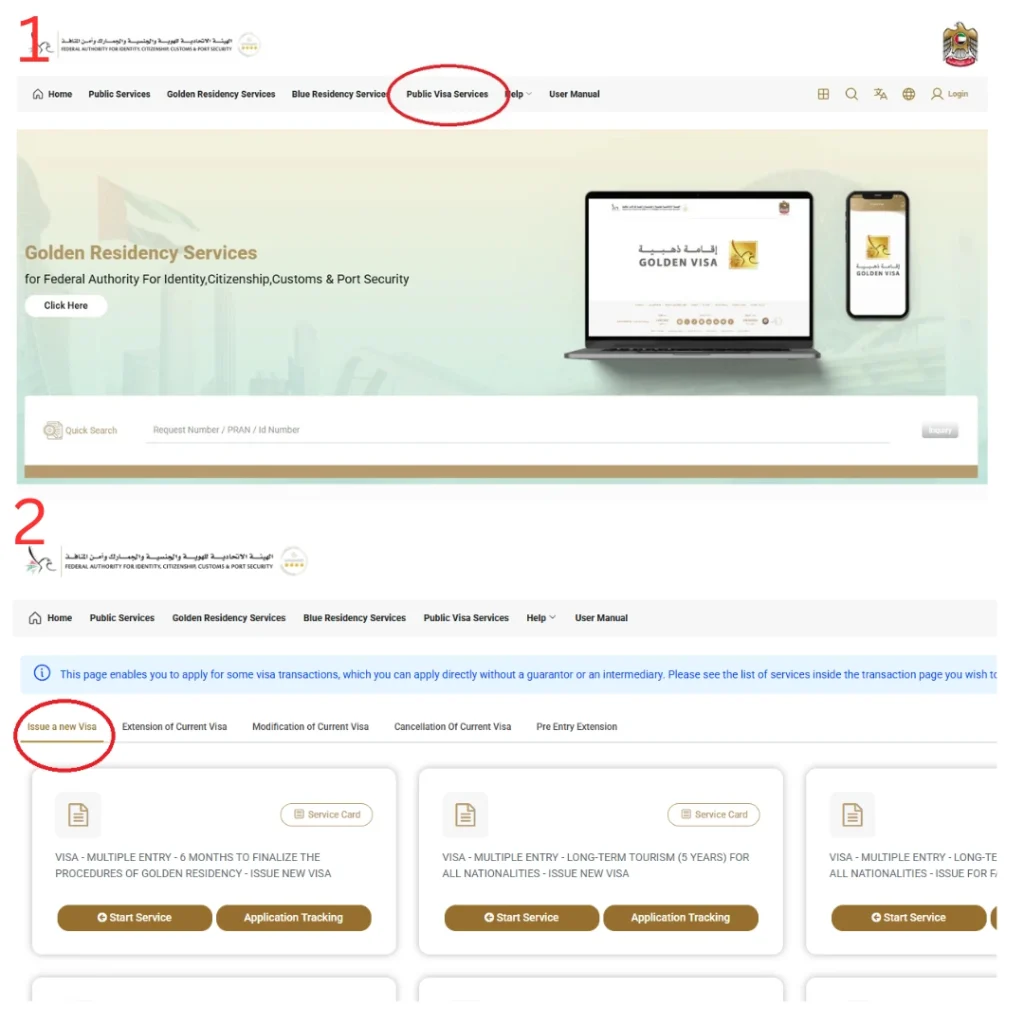
- Go to the Public visa services on ICP, select “ issue the new visa: option on this page. Now you can apply for the visa of your choice.
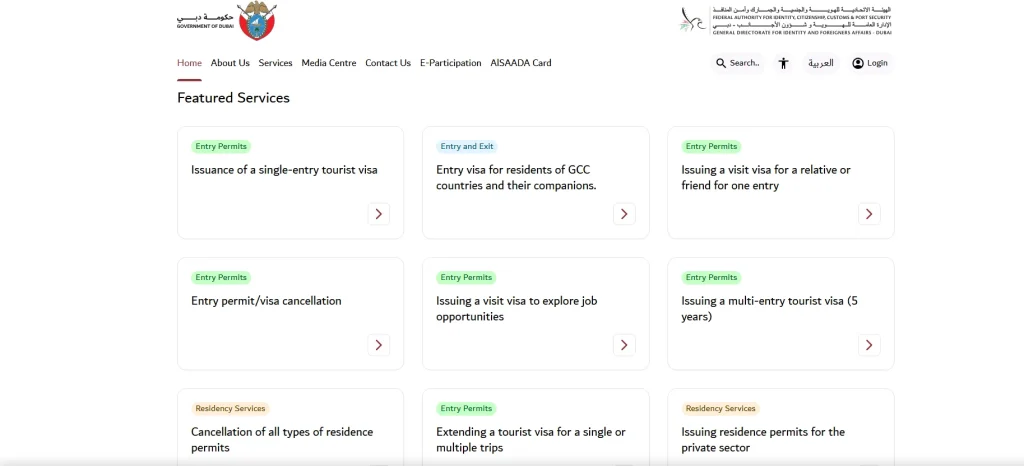
- On GDRFA, go to its home page, and you will see different options to apply for different visas under the featured services section. You can apply from there
- Step 2: Parents enter the UAE within 60 days
- Step 3: Medical tests for both
- Step 4: Pay security deposit at ICP or GDRFA (keep the receipt)
- Step 5: Submit residence application
- Step 6: Visa issued for 1 year
- Step 7: Renew every year
Heads up: Some nationalities face extra scrutiny. Pakistani, Indian, and Filipino applicants may need additional documents. Check with your typing center before applying.
Newborn Baby Visa, Don't Miss the Deadline
If your baby is born in the UAE, you have 120 days from birth to apply for their residence visa. Miss it, and fines start piling up.
What You’ll Need
| Document | Where to Get It |
| Birth certificate | Hospital → Ministry of Health attestation |
| Baby’s passport | Your embassy or consulate |
| Your passport and visa copy | Your own documents |
| Marriage certificate | Attested copy |
| Baby’s photo | White background, recent |
| Medical test report | For baby (usually quick check-up) |
Step-by-Step
- Step 1: Register the birth at the hospital. They'll give you a birth notification.
- Step 2: Take it to the Ministry of Health for attestation. They issue the official birth certificate.
- Step 3: Apply for baby's passport at your embassy. Processing time varies by country. Start this immediately.
- Step 4: Once the passport arrives. Log in to ICP.
- Step 5: Select "Issuance of visa" under the public visa services option on the homepage.
- Step 6: Upload:
- Birth certificate
- Baby’s passport copy
- Your passport and visa
- Marriage certificate
- Baby’s photo
- Step 7: Pay the fees.
- Step 8: Take the baby for a medical check-up (most centers do infant checks quickly).
- Step 9: Receive visa approval and apply for Emirates ID.
Fines if you’re late: AED 25 per day (approximate). The clock starts ticking after day 120.
A real talk moment: The passport is usually the bottleneck. Some embassies take weeks. Apply for it the moment you have the birth certificate. Don’t wait.
Children Above 18, The Rules Change
Once your child turns 18, the rules shift. Here’s how it works.
Child | Rule |
Sons | Can be sponsored until age 25 if unmarried, studying, or not employed |
Unmarried daughters | Any age. No limit. |
Sons of determination | Any age. No limit. Provide medical proof. |
Employed sons | Must have their own visa if working full-time. |
- Proof they’re unmarried (affidavit or certificate)
- If studying: enrollment letter from university
- If not studying: proof they’re not employed (or they need their own visa)
- Get his own employment visa
- Leave the country
- Apply for a different visa type (student, investor, etc.)
Quick tip: Start planning before the 25th birthday. Don’t wait until the visa expires.
What Happens If You Lose Your Job?
Nobody likes thinking about this. But it’s better to know.
If your employment ends, your visa is cancelled. And when your visa goes, your family’s visas go with it. During this stressful time, you can track visa application status for any new applications you submit to ensure there are no gaps in your family’s residency.”
Situation | What Happens |
Your visa cancelled | Family visas also cancelled automatically |
Grace period | 30 days (sometimes 60) to find new job |
Family during grace period | They can stay while you look |
If you find new job | Transfer your visa, then transfer family |
If you leave UAE | Family must leave or find new sponsor |
What "Cancelled Automatically" Means
You don’t get a choice. The system links family visas to yours. When yours stops, theirs stop. No separate grace period for them.
Can They Stay If You Leave?
Only if someone else sponsors them. You can’t. If you’re leaving for good, they leave too.
What to do: If you’re between jobs, be honest with your family. Plan together. The 30 days pass fast.
Documents You'll Need
For most family sponsorship applications, you’ll need :
- Your passport copy and Emirates ID
- Family member’s passport copy (valid 6+ months)
- Family member’s photo (white background)
- Marriage certificate (attested, translated if needed)
- Birth certificates for children (attested)
- Salary certificate or employment contract
- Tenancy contract (attested)
- Medical fitness certificates (for family members over 18)
- Security deposit (for parents)
Important Notes
Keep these things at the back of your mind.
- A mother can sponsor her children in special cases approved by ICP.
- If the sponsor’s visa is cancelled, dependents’ visas are also cancelled, but they get a 6-month grace period to regularize their status.
- Parents’ visas are issued for one year at a time, regardless of the sponsor’s visa duration.
- For children born in the UAE, apply for their residence visa within 120 days of birth to avoid fines. Otherwise, you face the consequences later.
Common Reasons Family Visas Get Rejected
Most rejections aren’t because of big things. They’re small mistakes. Here’s what to watch for.
Reason | How to Avoid It |
Salary below threshold | Check the requirements before you apply. Don’t guess. |
Unattested marriage certificate | Get it attested in your home country AND the UAE. Both steps matter. |
Unattested birth certificates | Same rule. Attest everything. |
Blurry documents | Scan clearly. If they can’t read it, they reject it. |
Expired passport | Check expiry dates. Passport must be valid 6+ months. |
Wrong photo format | White background. Recent. No glasses. No shadows. |
Previous overstay | Clear any fines before applying. The system checks. |
Accommodation too small | The tenancy contract should show enough rooms for the family size. |
Medical test failure | Some conditions can be treated. Check before flying family here. |
Applying through wrong portal | Dubai = GDRFA. Others = ICP. Pick right. |
Double-check everything before you hit submit. One typo can mean weeks of delay.
Renewing Your Family's Residence Visa
Don’t wait until the last day. Start renewal 30 days before expiry.
Step-by-Step
- Step 1: Log in to ICP or GDRFA.
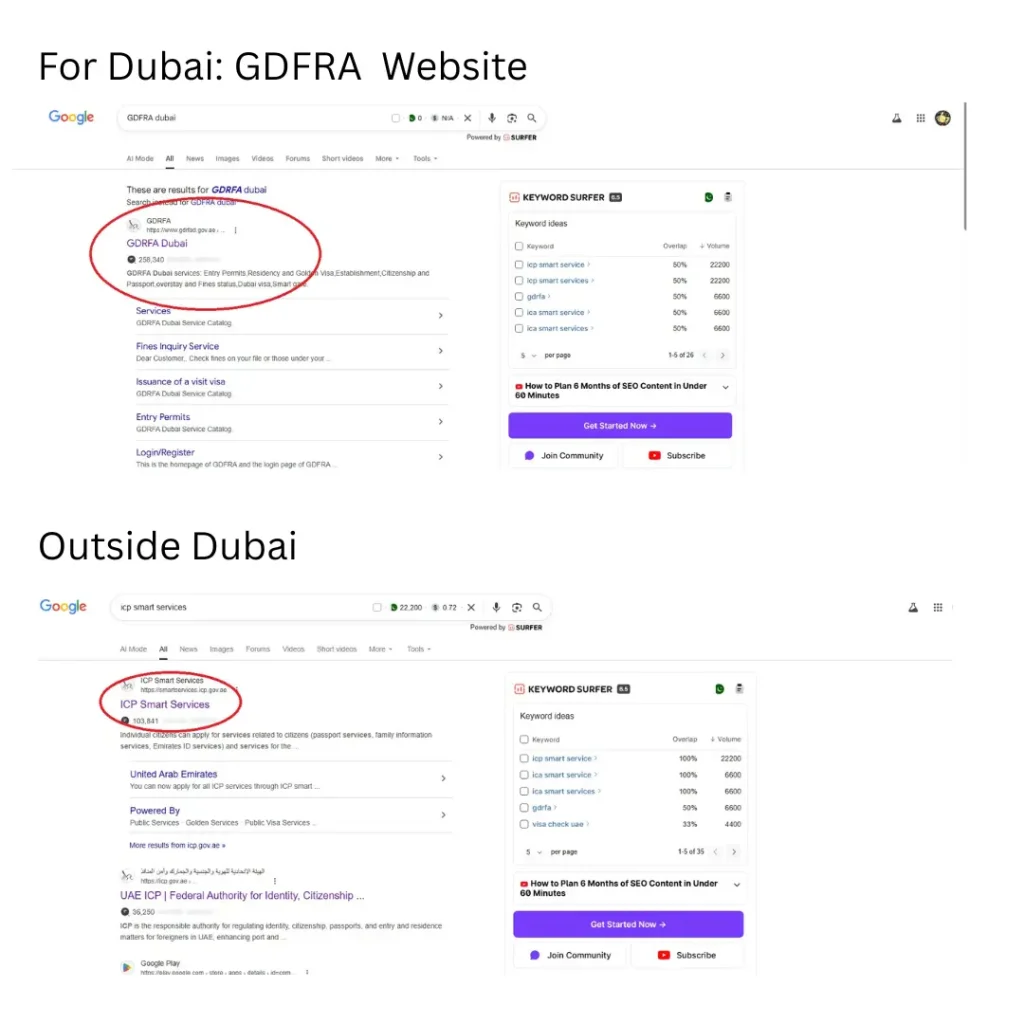
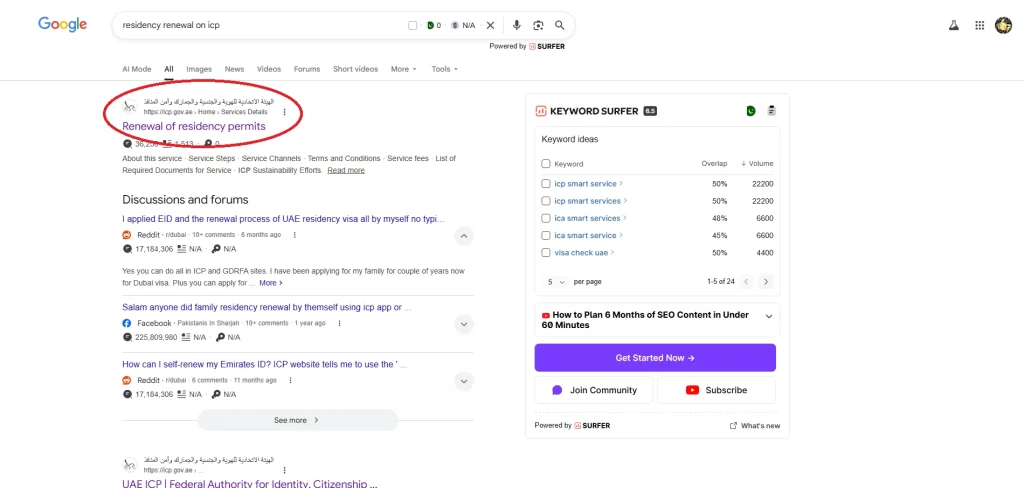
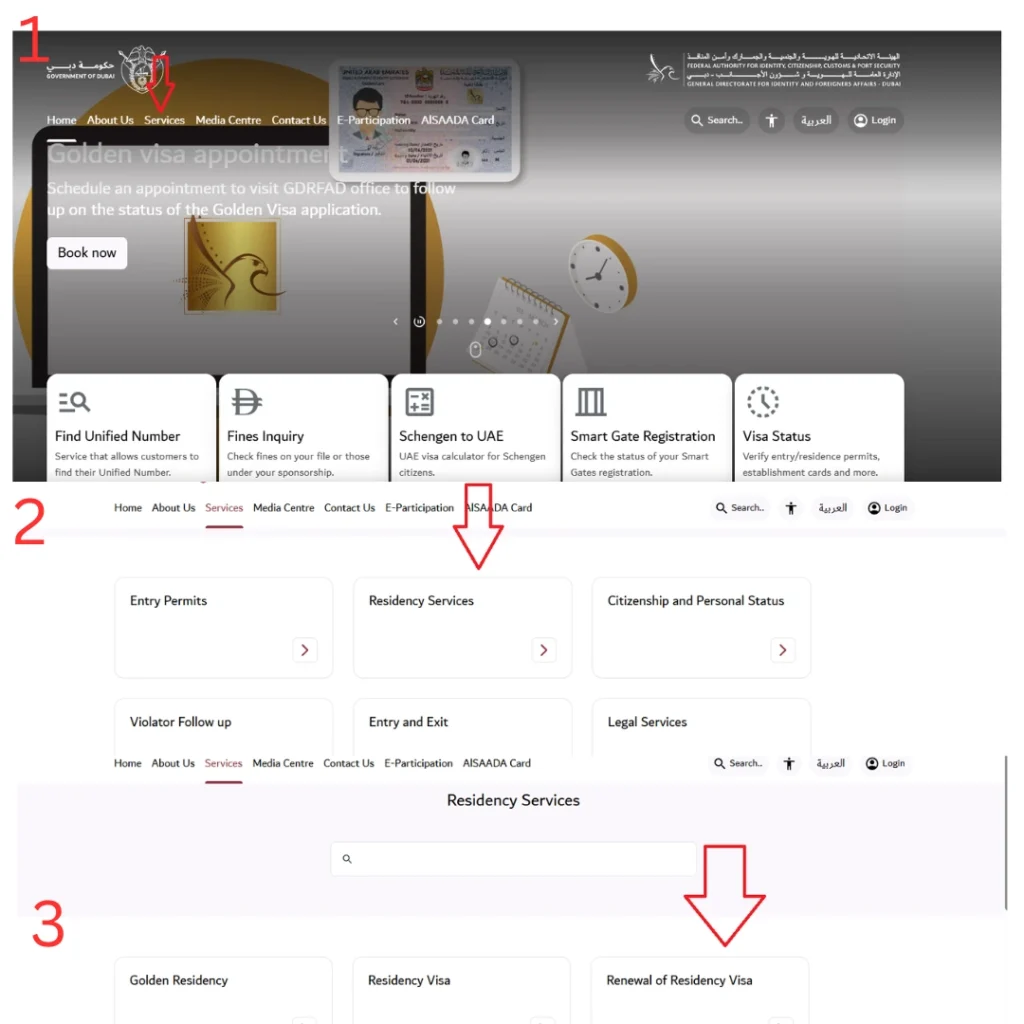
- Step 2: Renewing family residency visas requires two steps: Emirate ID renewal and then a visa application through the residency renewal option on the official website. On ICP you can directly search for the residency renewal option on Google if the navigation path on the website is difficult.
- On GDRFA, select services on the homepage, then go to residency services under the service page and select the residency renewal option.
- Step 3: Choose the appropriate option.
- Step 4: Upload any updated documents (passport copy, photo).
- Step 5: Pay the fees:
- Visa renewal fee
- Emirates ID renewal fee
- Medical test fee (if required)
- Step 6: If a medical test is needed (every few years), visit an approved center.
- Step 7: Receive a new visa electronically.
- Step 8: New Emirates ID arrives by courier within 1-2 weeks.
Cost: Similar to the initial application but without the entry permit fee. Expect AED 2,000–3,500 per person, depending on the emirate and visa duration.
Once you’ve submitted, you can track your family visa status online
A good habit: Set calendar reminders for 45 days before expiry. Gives you wiggle room if something goes wrong.